
(DE)CONSTRUCTED LAKE
- Year
- 2024-2026
- Technique
- Photographie, Collage, Digitaldruck
- Material
- Druck hinterleuchtet
- Dimensions
- 60 × 60 × 6 cm
- Edition of
- 5
+ AR layer
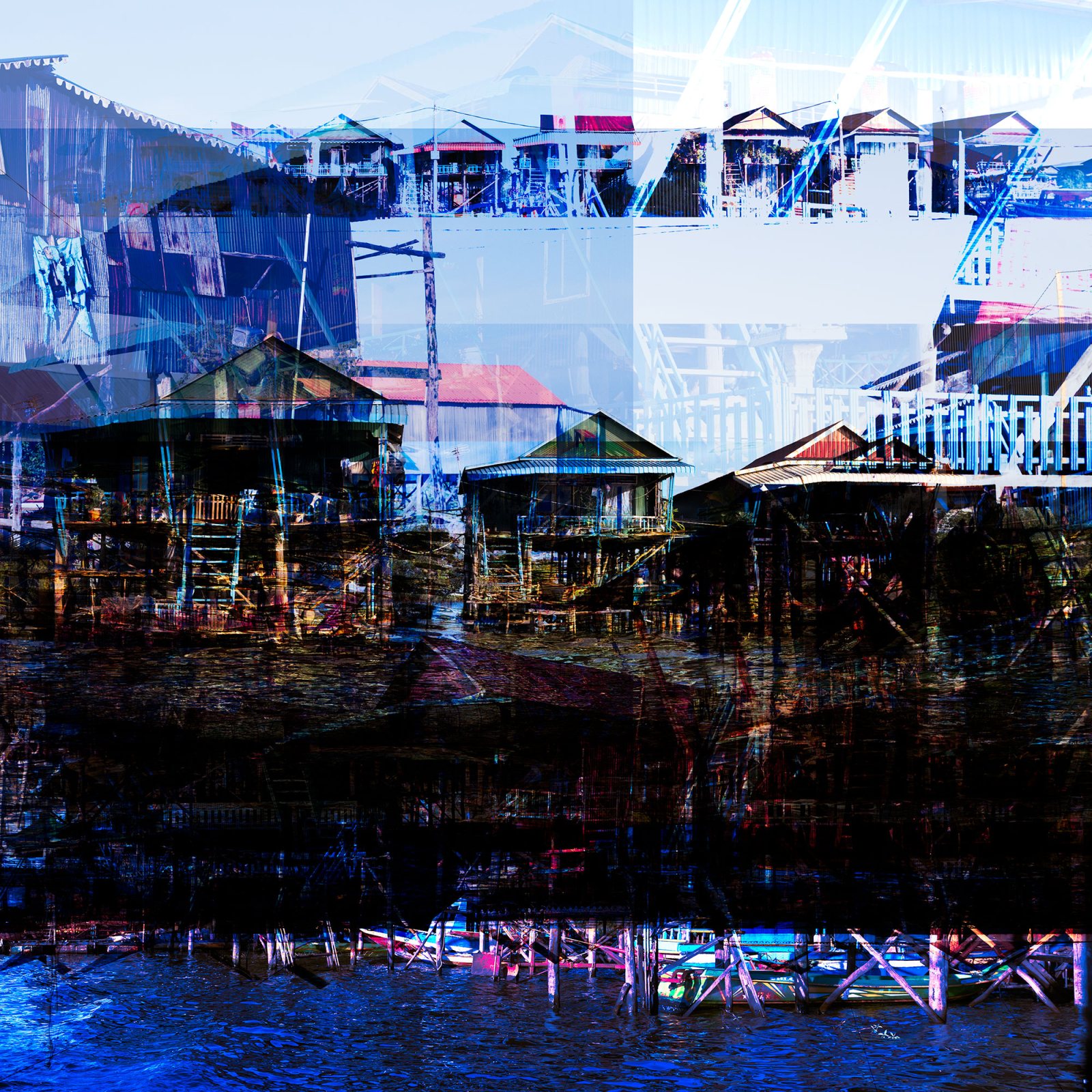
Above, the stilt houses hover like a typesetting case, bright and almost overexposed. Below, in the water, they stand on slender stilts, with colourful boats in between. And in the middle lies a dark band, heavy as a shadow. It is the layer that cannot be seen from the boat.
Tonle Sap is the largest freshwater lake in South-East Asia. Twice a year, its flow reverses direction. In the rainy season, the Mekong pushes water into the lake; in the dry season, it flows back out. The houses, the fish and the people all live in tune with this rhythm. But today, this rhythm arrives weeks later than it used to, because there are dams on the Mekong. The lake is no longer a purely natural phenomenon. It is being shaped by human intervention: constructed.
The consequences lie beneath the surface. Phew. Between 2003 and 2019, the lake’s fish stocks shrank by 87.7 per cent. Around 80,000 people live in floating villages, without a sewage system. The water beneath their homes serves as drinking water, washing water and a toilet all at once. Since 2015, the government has been relocating floating villages to the mainland: deconstructed.
The stilt houses are a clever piece of architecture: air circulates from below, and the house follows the water level. The question raised by the image is how much longer the lake will continue to follow its own pulse.